Wednesday, October 19, 2011

The Movie Is Playing


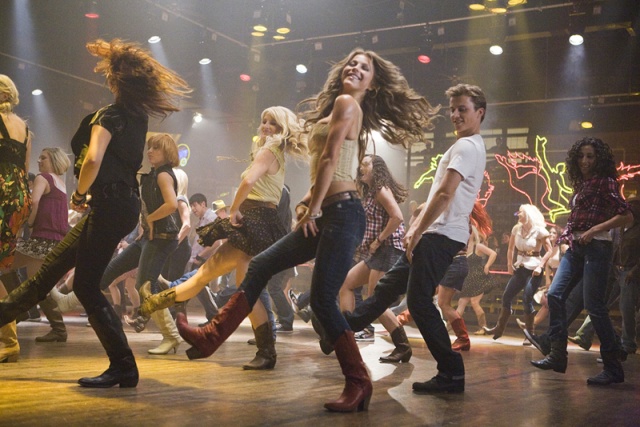
It was a rainy day on Cape Cod today and my daughter and I had planned to see Footloose after I got off work, so we went and got taken away from the rain, and I got taken away from the stress and the fact that I devote hours to planning my classes and I don’t make enough to pay all the bills, by this silly, schmaltzy, fun fantasy world where everyone is so good-looking and can dance so well, and it was worth seeing just for the first part of the “Let’s Here it for the Boy” routine, the cutest moment in any film I’ve seen this year. Man, we loved it! Sometimes, it doesn’t matter what I see. Last Friday, I had wanted to see Take Shelter or The Mill and the Cross, but the arties and the indies don’t get to the Cape until a month or so after their release, if at all, and so I saw The Thing and Real Steel, the latter providing the same sort of silly escapist fantasy as Footloose, and I had a very enjoyable evening.

My favorite movie this year has been The Tree of Life, which I went to see in May on opening weekend in New York City. (It didn’t make the Cape until July.) I’ve been looking forward to seeing Kirsten Dunst in Lars von Trier’s Melancholia, but I knew it might not even make the Cape, and I learned that it was on Comcast, so I decided not to risk missing its theatrical release and watched it three times.


(In way of contrast, I watched von Trier’s Antichrist on Netflix. Interesting connections. Some amazing imagery. Same use of extreme slow motion and some recurrent symbolism: the bridge that’s hard to cross. As for some of the more graphic images, I liked the whetstone bolted to Willem Dafoe’s calf, but his bloody you-know-what was hard to take.)


I love all kinds of movies. I’m an equal opportunity viewer, and I’ll see a movie anywhere, anytime. One of my most memorable viewings of all time was seeing Zulu Dawn with my wife in one of the last, crumbling single-screen cinemas on Market Street in San Francisco where homeless people and pushers and pimps paid the two bucks to get off the streets or hide.


Saturday, October 15, 2011

Robots & Aliens: Real Steel and The Thing (2011)


As a prequel to John Carpenter’s 1982 film, The Thing (2011) does a nice job of building some of the same tension as paranoid scientists in a small Antarctic outpost suspect each other of being infested by an alien life form found frozen in the ice, and all the running around and bursting with alien tentacles and incinerating said tentacles and monstrosities with flamethrowers (Why does an Antarctic research outpost have flamethrowers?) is done in a set that is a faithful replica of the one for the 1982 film. Meanwhile, Mary Elizabeth Winstead, as paleontologist Kate Llyod, does a very good job of showing fear in tight situations and emerging as the clever survivor, blazing away with her flamethrower like Ellen Ripley and wisely refusing to trust anyone. And even though the movie connects the dots niftily with the Carpenter film whose storyline it precedes, the end product provides only moderate chills and suspense, and it left me wondering why it essentially remakes the 1982 film when the storyline and premises of Howard Hawks’s 1951 film, The Thing from Another World, would have been much more interesting to revisit.


Family-friendly director Shawn Levy’s film Real Steel tugs at every emotional chord in a film whose performances are so over the top that you suspect there’s an overacting competition going on among the cast, but you eventually find yourself won over by the film’s touching core achieved by the relationship between bitter, wayward ex-boxer Charlie Kenton (Hugh Jackman), who drives all over the country, fixes up boxing robots, and fights them at fairs and carnivals, and Max (Dakota Goyo), his son he hasn’t seen since birth.

Saturday, October 1, 2011

Oregon Trail Vérité: Meek's Cutoff (2011)


Want to know what it was like traveling the Oregon Trail in 1845? Watch Kelly Reichardt’s Meek’s Cutoff, which follows the ordeal of a small train of three wagons and three families crossing the rugged high desert of Oregon, the travelers’ lives depending on trusting Stephen Meek (Bruce Greenwood) and his dubious cutoff or a mysterious Indian (Ron Rondeaux), who seems to be leading them toward water.

Of all the movies I’ve seen about the Oregon Trail, this is the only one that is historically accurate about the details: the small, narrow wagons pulled by oxen; the travelers walking along at the pace of the oxen; the tedium and back-breaking labor of fording a river or lowering wagons down a steep incline; collecting scarce firewood from amidst the sage; the long, hot days; the nights darker than we know a night can be.


Sunday, September 25, 2011

"How can you not be romantic about baseball?" - Moneyball


“How can you not be romantic about baseball?” This is what discouraged GM Billy Beane (Brad Pitt) of the Oakland A’s says when his unlikely assistant manager, Peter Brand (Jonah Hill), a Yale graduate who uses statistics and calculations to find capable undervalued players at the lowest cost, shows him an endearing video in which an overweight player hits a high ball, gets to first base, falls in an attempt to round first, and ends up scrabbling for the base on hands and knees, only to learn that he has hit a homer. Brad Pitt's Beane seems to send the question in three directions: toward his tubby, socially taciturn assistant manager who seems too immersed in numbers to have a passion for the game (even though he watches the games and Beane doesn’t); toward Beane himself, who may have lost a lot of that passion after being drafted as a promising star, only to reveal that he didn’t have the right stuff; and toward the audience, which might include a viewer like me who doesn’t share that passion at all and doesn’t follow baseball to the extent that I had no idea who Billy Beane was or what the Oakland A’s achieved in their 2002 season.


Indeed, it would be very hard not to be romantic about baseball, watching Bennett Miller’s meticulously made Moneyball, which includes memorable writing, solid performances, and striking cinematography that breaks out of the claustrophobia of the Oakland A’s cramped, austere offices and locker room to frame long shots of Beane in isolation or the infield lights of the ballpark fading to mist. From opening shots to the final poignant extreme close-up, Moneyball never hits a false note for me. Scene after carefully staged scene makes you feel emotion for a game played with a bat and a ball by players who don’t need to have the agility of basketball players or the strength of football players but who must have that elusive knack and built-in confidence that ensure they can make the ball go somewhere, anywhere, and get on base.

Sunday, September 11, 2011

Not Catchy Enough: Soderbergh's Contagion


(To avoid spoilers, jump to second paragraph.)

A contagious virus, spread by human breath or touch, infects individuals in Macau, and they take the disease all over the world. Their contact with other humans spreads the disease exponentially. Researchers race to identify the malignancy. Once it is identified, doctors endeavor to develop a vaccine. Victims die in droves. People panic and riot for food. A paranoid conspiracy theorist uses his blog to raise suspicions about incompetent government handling of the crisis. The blogger also says that he has discovered a homeopathic cure. A disease investigator is kidnapped; the ransom price is a supply of vaccinations. Fear escalates. More riots. Rage. Chaos.

It’s all possible, and at its best, Steven Soderbergh’s Contagion vividly charts the escalation of panic and chaos, with tensely staged vignettes set in Macau, Hong Kong, Chicago, London, D.C., and San Francisco. In addition, a star-heavy cast, that includes Gwyneth Paltrow, Matt Damon, Laurence Fishburne, John Hawkes, Jude Law, Kate Winslet, Marion Cotillard, Jennifer Ehle, Elliot Gould, and an as-himself cameo by Dr. Sanjay Gupta, helps establish our sympathies when wooden acting and the film’s distancing matter-of-fact tone fail to win them.

After a poorly written couple of speeches in which Matt Damon’s mild-mannered father, Mitch Emhoff, uses the word “sweetie” at least six times as he watches his wife (Paltrow) go into convulsions on the kitchen floor and as he warns his step-son to stand back, Damon grounds the film and provides its emotional core with his performance as a loving father determined to help his daughter survive the epidemic. As Erin Mears, a doctor in charge of the overwhelming task of containing the disease, Kate Winslet is totally invested, as Kate Winslet always is. Meanwhile, Marion Cotillard’s appearance as the kidnapped doctor is an afterthought; Fishburne’s performance is painfully bland; and Elliot Gould is downright dreadful.

Monday, September 5, 2011

Not Swiss Cheese: Apollo 18


Borrowing the style of the “actual footage” genre, Apollo 18 adopts science fiction trappings and takes us to the moon where it builds more suspense and delivers more satisfying chills than all the thumps in the night of the Paranormal Activity movies.

Purporting to be the found footage of the top secret, forgotten Apollo 18 Mission, the movie sets out to reveal why NASA has stayed away from the moon since the 70s. Needless to say, crew members Ben (Warren Christie), Nate (Lloyd Owen), and John (Ryan Robbins) encounter more than just lifeless moonscapes, but I shall reveal no details here. As Ben, Warren Christie is especially intense and convincing as his blandly technical astronaut's tone turns to panic.

Since the story takes place in 1974, the crew members employ fixed 16 mm cameras (no camcorders here), and we get some stark black and white shots of the astronauts isolated in a barren terrain, an atmosphere which sets an eerie tone. Meanwhile, the claustrophobic lunar landing module, along with the delicate limits of the protection it offers, intensifies the urgency of the danger. If a demon haunts your house, you can leave the room or go stay with a friend, but on the moon there are no neighbors.

As a big-budget, color film enhanced with elaborate CGI, Apollo 18 could have been a major sci-fi epic, but what the filmmakers achieve here with three actors, a couple of tight interior sets, and murky shots of the lunar wasteland is quite impressive. This is an enjoyable little movie.