Tuesday, November 15, 2011

Indies Out There

While Hollywood slings out fare like The Three Musketeers - 3D, major films like Eastwood's J. Edgar vie for the Oscars. In J. Edgar, Leonardo DiCaprio as J. Edgar Hoover invests himself in his role, especially in the earlier past that explores the formation of his F.B.I., but when the film focuses on the 60s and 70s and features cardboard portrayals of Robert F. Kennedy and Richard Nixon, DiCaprio and Armie Hammer, as Clyde Tolson, J. Edgar's "boyfriend," totter around in puffy, pasty-white old-age makeup that constricts their speaking and turns some of their scenes into ready-made parody. Meanwhile, smaller movies have delivered notable performances and provocative stories.


In Melancholia director Lars van Trier juxtaposes stunning imagery with Kirsten Dunst's visceral portrayal of Justine, a woman suffering from deep depression while a newly discovered planet, named Melancholia, advances meaningfully on a collision course toward Earth. I have already reviewed this film here, so I won’t add more than to say that so far this year Melancholia ranks second place to The Tree of Life on my list of the best films of 2011.


In Take Shelter, is Curtis seeing signs of an impending apocalyptic storm or is he succumbing to the schizophrenia that put his mother in an institution? The direction of Jeff Nichols and the fine performance of Michael Shannon, as the taciturn, haunted Curtis, leave the answer a mystery as Curtis's paranoia builds, he tears up the back yard to enlarge his storm shelter, and his nightmares of storms and zombies and plagues of birds right out of Hitchcock's The Birds become more horrific.

Throughout all this, Jessica Chastain as Samantha, Curtis's wife, is understanding and compassionate but firmly assertive when Curtis's weird behavior gets Curtis fired and threatens the family's security. While Curtis refuses to believe that his premonitions are not real, Samantha plans how the family can survive financially. Once again Chastain plays the ideal wife and mother, as she did in The Tree of Life, and once again her performance is perfect.

Shannon nicely plays the line between his acknowledgement of the possibility that he is manifesting schizophrenia and his firm conviction that a big storm is coming. Though the stunning ending is up for interpretation, the story delivers satisfying drama and a genuinely creepy atmosphere that strengthens a number of very gripping scenes.

Sunday, November 6, 2011

O for a Muse of Fire, Flood, and Alien Invasion: Roland Emmerich's Anonymous


Well known for destroying Los Angeles in Independence Day (1996), New York in The Day After Tomorrow (2004), and practically the whole planet in 2012 (2009), Roland Emmerich attempts to destroy the widely held belief that William Shakespeare wrote the plays attributed to his authorship, taking on the theory that Edward de Vere, the 17th Earl of Oxford, was the real author of the plays.

Emmerich has a talent for the grandiose, but the most memorable aspects of Emmerich’s great disaster films are visual, and the overly talkie Anonymous becomes claustrophobic as it sets up the circumstances for de Vere’s production of his provocative plays under the name of William Shakespeare (Rafe Spall), a vain, illiterate, shameless fop who is more than willing to take a free ride on another man’s talent. Much more time is spent indoors as de Vere (Rhys Ifans) becomes embroiled in confusing court intrigue surrounding the succession of Queen Elizabeth I, played over the top by Vanessa Redgrave as a silly old woman still primping herself for her swains. Additional time is spent chronicling Elizabeth’s scandalous choices of bedfellows.


Panoramic CGI shots of Elizabethan London, like the one above, breathe life into the film, but these moments are few and far between. Instead, the plot follows conniving earls and the hunchbacked villainy of Robert Cecil (Edward Hogg), supposedly the basis for Shakespeare’s hunchbacked characterization of Richard III. The film’s best scenes, however, take place in the theatre and depict what it must have been like to view the first performances of Henry V, Romeo and Juliet, and Hamlet. Emmerich overplays the rapture of the Elizabethan audience witnessing Shakespeare’s plays with shots of tear-filled eyes and female groundlings swooning over Romeo. Apparently, at the time, Shakespeare was just another very good playwright during a renaissance of great theater, and many of his speeches are merely utilitarian. But these scenes, staged with compelling authenticity, are full of rich atmosphere and energy, elements lacking from the rest of the film.

Wednesday, October 26, 2011

God's Manic Depressive: Melancholia


(SPOILERS - DEFINITELY)

Lars von Trier’s Melancholia opens with a devastating image. Justine, played by Kirsten Dunst, stands facing the camera. Under heavy lids, her eyes open slowly, halfway. Her limp hair hangs in unwashed strands. Behind her, dead birds fall from the sky. Like Thomas Wolfe’s “God’s lonely man,” Justine peers into the abyss. In this case it is an abyss of depression. What follows this perfect metaphor for depression is a montage of images, some symbolic, some presaging what is yet to unfold, some rendered in such extreme slow-motion that movement is barely perceptible. To the music of Richard Wagner’s brooding prelude for Tristan and Isolde, we see ashes falling over Peter Bruegel’s painting “Hunters in the Snow.” Justine, in her white wedding gown, struggles to run, held back by heavy strands of black yarn. A horse collapses under a black, apocalyptic sky. A woman carrying a young boy moves imperceptibly across a golf course. Planets collide.


This examination of deep-seated depression in the shadow of impending, very metaphorical, cosmic catastrophe, is divided into two parts. “Part One: Justine” covers the disaster of Justine’s wedding reception as she succumbs by increments to the depression that has ruled her life. Her father (John Hurt) acts childishly and gives a toast that antagonizes his ex-wife (Charlotte Rampling). Justine’s mother responds with a bitter declaration about the absurdity of marriage. Michael (Alexander Skarsgard) makes an innocent proclamation of deep affection but becomes more and more alienated from his bride as Justine leaves the wedding party to lounge in a bath, drive a golf cart around the golf course, tell her boss how much she despises him, and do anything to avoid becoming intimate with her husband. Throughout all this, Justine’s sister, Claire (Charlotte Gainsbourg), tries futilely to stop Justine from falling apart, and Justine’s brother-in-law, John (Kiefer Sutherland), tries to act the dignified host while regarding Justine’s family and her behavior with haughty disgust.


Wednesday, October 19, 2011

The Movie Is Playing


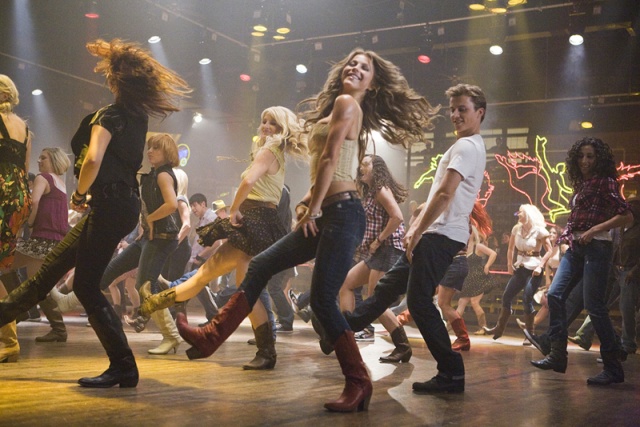
It was a rainy day on Cape Cod today and my daughter and I had planned to see Footloose after I got off work, so we went and got taken away from the rain, and I got taken away from the stress and the fact that I devote hours to planning my classes and I don’t make enough to pay all the bills, by this silly, schmaltzy, fun fantasy world where everyone is so good-looking and can dance so well, and it was worth seeing just for the first part of the “Let’s Here it for the Boy” routine, the cutest moment in any film I’ve seen this year. Man, we loved it! Sometimes, it doesn’t matter what I see. Last Friday, I had wanted to see Take Shelter or The Mill and the Cross, but the arties and the indies don’t get to the Cape until a month or so after their release, if at all, and so I saw The Thing and Real Steel, the latter providing the same sort of silly escapist fantasy as Footloose, and I had a very enjoyable evening.

My favorite movie this year has been The Tree of Life, which I went to see in May on opening weekend in New York City. (It didn’t make the Cape until July.) I’ve been looking forward to seeing Kirsten Dunst in Lars von Trier’s Melancholia, but I knew it might not even make the Cape, and I learned that it was on Comcast, so I decided not to risk missing its theatrical release and watched it three times.


(In way of contrast, I watched von Trier’s Antichrist on Netflix. Interesting connections. Some amazing imagery. Same use of extreme slow motion and some recurrent symbolism: the bridge that’s hard to cross. As for some of the more graphic images, I liked the whetstone bolted to Willem Dafoe’s calf, but his bloody you-know-what was hard to take.)


I love all kinds of movies. I’m an equal opportunity viewer, and I’ll see a movie anywhere, anytime. One of my most memorable viewings of all time was seeing Zulu Dawn with my wife in one of the last, crumbling single-screen cinemas on Market Street in San Francisco where homeless people and pushers and pimps paid the two bucks to get off the streets or hide.


Saturday, October 15, 2011

Robots & Aliens: Real Steel and The Thing (2011)


As a prequel to John Carpenter’s 1982 film, The Thing (2011) does a nice job of building some of the same tension as paranoid scientists in a small Antarctic outpost suspect each other of being infested by an alien life form found frozen in the ice, and all the running around and bursting with alien tentacles and incinerating said tentacles and monstrosities with flamethrowers (Why does an Antarctic research outpost have flamethrowers?) is done in a set that is a faithful replica of the one for the 1982 film. Meanwhile, Mary Elizabeth Winstead, as paleontologist Kate Llyod, does a very good job of showing fear in tight situations and emerging as the clever survivor, blazing away with her flamethrower like Ellen Ripley and wisely refusing to trust anyone. And even though the movie connects the dots niftily with the Carpenter film whose storyline it precedes, the end product provides only moderate chills and suspense, and it left me wondering why it essentially remakes the 1982 film when the storyline and premises of Howard Hawks’s 1951 film, The Thing from Another World, would have been much more interesting to revisit.


Family-friendly director Shawn Levy’s film Real Steel tugs at every emotional chord in a film whose performances are so over the top that you suspect there’s an overacting competition going on among the cast, but you eventually find yourself won over by the film’s touching core achieved by the relationship between bitter, wayward ex-boxer Charlie Kenton (Hugh Jackman), who drives all over the country, fixes up boxing robots, and fights them at fairs and carnivals, and Max (Dakota Goyo), his son he hasn’t seen since birth.

Saturday, October 1, 2011

Oregon Trail Vérité: Meek's Cutoff (2011)


Want to know what it was like traveling the Oregon Trail in 1845? Watch Kelly Reichardt’s Meek’s Cutoff, which follows the ordeal of a small train of three wagons and three families crossing the rugged high desert of Oregon, the travelers’ lives depending on trusting Stephen Meek (Bruce Greenwood) and his dubious cutoff or a mysterious Indian (Ron Rondeaux), who seems to be leading them toward water.

Of all the movies I’ve seen about the Oregon Trail, this is the only one that is historically accurate about the details: the small, narrow wagons pulled by oxen; the travelers walking along at the pace of the oxen; the tedium and back-breaking labor of fording a river or lowering wagons down a steep incline; collecting scarce firewood from amidst the sage; the long, hot days; the nights darker than we know a night can be.