Saturday, November 26, 2011

The Wonders of Hugo


The greatest wonder of Martin Scorsese’s Hugo is the production design of Dante Ferretti. In the film’s leisurely prologue, Hugo (Asa Butterfield), the orphaned boy who lives in the station and winds the many clocks, moves through the set for the Gare de Montparnasse that is much more than a little world film set. It is all of Paris under one roof. Here, Hugo weaves through busy shopkeepers and people rushing off to trains, pursued by Station Master (Sacha Baron Cohen) and his black Doberman, and he passes the café proprietress with her long-haired dachshund and the shy old man whose fancy for the woman is thwarted by her snapping dog, and we easily get a sense of the size of this world within a world, with its alleys and passageways into attics and clock towers. We hardly ever leave the station, except in flashback or to go to Isabelle's house, but we don’t need to. Here, all the world’s a train station.


Of the wonderful performances in a fine cast, my favorite is Sacha Baron Cohen as Station Master. He is slender and ramrod-stiff, impeccable in his bright blue uniform, but any authority is lost when he runs haltingly with his leg in a rusty brace, gets caught up on a train door, and dragged down the platform, a wonderful routine fit for the silent film era to which Scorsese's film pays tribute. An orphan in his youth, Station Master captures runaway orphans hiding in the station so that they can be sent to the orphanage where they will learn life the hard way as he did. Cohen is controlled, thoughtful, sensitive in every glance and articulation, and his smiles attempted to please the pretty flower salesgirl (Emily Mortimer) he loves are a laugh. But the film is led by the performances of Asa Butterfield as Hugo and Chloë Grace Moretz as Isabelle, the girl who joins Hugo in his quest to fix a mechanical man and understand the message the automaton delivers. As the young girl who has only found adventure in books, Moretz is especially talented and graceful in her role. Cutting out a tendency to overact, Ben Kingsley delivers a fine performance as filmmaker Georges Méliès, and it is magical how CGI transforms Kingsley into the young Georges, the stage magician who becomes a cinematic magician.

Saturday, November 19, 2011

Immortal Imagery: The Immortals


The Immortals is well worth seeing for its thrilling story, gripping action, and more than serviceable acting, but it is a must-see for the amazing imagery of Tarsem Singh (The Cell (2000) and The Fall 2008).

The story is a simple Greek mythological tale of heroes and formidable foes. The most formidable foe is King Hyperion, played by Mickey Rourke, looking much like he did in The Wrestler, beefy, craggy, and wearing his hair in long greasy strands, with the added threat of a deep, croaky voice. Theseus, the hero, is played by Henry Cavill, handsome and muscular. Bitter at the gods because the gods just don’t seem to care, Hyperion wants the magical Epicus bow (a cross between the elven bow of Legolas’s and an RPG launcher) in order to release the Titans (wiry zombie-like dudes imprisoned with iron bars chained to their mouths) and battle the gods, golden armored denizens of Mount Olympus wearing hats that look like they were designed by haute couture fashion designers who make models look like they come from another planet.

In a film featuring much manly slow-mo swordplay and buckets of blood, a nice calming effect is supplied by Freida Pinto as Phaedra, the virgin (not for long) oracle. Athena, played by Isabel Lucas, dressed in a little bit of golden armor, is nothing short of wow!


But The Immortals is all about the art direction. (Well, considering Athena and the gripping combat, not quite.) The sets for cliffside villages, palace chambers, and temples are modern minimalist design.


Even Mount Olympus is a simple circular platform with a few marble benches. The style of the imagery looks like something painted jointly by Maxfield Parrish and Thomas Cole.


But nothing detracts from the awesomeness of Tarsem’s expansive landscapes that stretch far beyond the limits of a framed image. In the middle of a vast wasteland, a wall and a steampunk gate guard the Titans at Mount Tartarus, and this is the setting for a battle between a vastly outnumbered group of heroes and a prodigious horde that gets channeled into a subway-like passageway.


Then it’s fast and slow-mo clashing and slashing before the gods come down and kick Titan butt in a scene that might well have made Sam Peckinpah sit up in his grave and gawk in envy. When Ares (Daniel Sharman) defies Zeus (Luke Evans) and helps the mortals, he pulverizes very slow-moving bad guys with a hammer while he moves at a faster godlike speed. It is a remarkable, very cool scene.

The violent combat is well staged, and for the most part it is not overbearing and belabored. Unlike 300, which is more about what you see than what you feel, The Immortals gives you characters and conflicts to care about once the action starts. Still, the set design and art direction stand out as the film’s best strengths and make The Immortals a movie to see.

Tuesday, November 15, 2011

Indies Out There

While Hollywood slings out fare like The Three Musketeers - 3D, major films like Eastwood's J. Edgar vie for the Oscars. In J. Edgar, Leonardo DiCaprio as J. Edgar Hoover invests himself in his role, especially in the earlier past that explores the formation of his F.B.I., but when the film focuses on the 60s and 70s and features cardboard portrayals of Robert F. Kennedy and Richard Nixon, DiCaprio and Armie Hammer, as Clyde Tolson, J. Edgar's "boyfriend," totter around in puffy, pasty-white old-age makeup that constricts their speaking and turns some of their scenes into ready-made parody. Meanwhile, smaller movies have delivered notable performances and provocative stories.


In Melancholia director Lars van Trier juxtaposes stunning imagery with Kirsten Dunst's visceral portrayal of Justine, a woman suffering from deep depression while a newly discovered planet, named Melancholia, advances meaningfully on a collision course toward Earth. I have already reviewed this film here, so I won’t add more than to say that so far this year Melancholia ranks second place to The Tree of Life on my list of the best films of 2011.


In Take Shelter, is Curtis seeing signs of an impending apocalyptic storm or is he succumbing to the schizophrenia that put his mother in an institution? The direction of Jeff Nichols and the fine performance of Michael Shannon, as the taciturn, haunted Curtis, leave the answer a mystery as Curtis's paranoia builds, he tears up the back yard to enlarge his storm shelter, and his nightmares of storms and zombies and plagues of birds right out of Hitchcock's The Birds become more horrific.

Throughout all this, Jessica Chastain as Samantha, Curtis's wife, is understanding and compassionate but firmly assertive when Curtis's weird behavior gets Curtis fired and threatens the family's security. While Curtis refuses to believe that his premonitions are not real, Samantha plans how the family can survive financially. Once again Chastain plays the ideal wife and mother, as she did in The Tree of Life, and once again her performance is perfect.

Shannon nicely plays the line between his acknowledgement of the possibility that he is manifesting schizophrenia and his firm conviction that a big storm is coming. Though the stunning ending is up for interpretation, the story delivers satisfying drama and a genuinely creepy atmosphere that strengthens a number of very gripping scenes.

Sunday, November 6, 2011

O for a Muse of Fire, Flood, and Alien Invasion: Roland Emmerich's Anonymous


Well known for destroying Los Angeles in Independence Day (1996), New York in The Day After Tomorrow (2004), and practically the whole planet in 2012 (2009), Roland Emmerich attempts to destroy the widely held belief that William Shakespeare wrote the plays attributed to his authorship, taking on the theory that Edward de Vere, the 17th Earl of Oxford, was the real author of the plays.

Emmerich has a talent for the grandiose, but the most memorable aspects of Emmerich’s great disaster films are visual, and the overly talkie Anonymous becomes claustrophobic as it sets up the circumstances for de Vere’s production of his provocative plays under the name of William Shakespeare (Rafe Spall), a vain, illiterate, shameless fop who is more than willing to take a free ride on another man’s talent. Much more time is spent indoors as de Vere (Rhys Ifans) becomes embroiled in confusing court intrigue surrounding the succession of Queen Elizabeth I, played over the top by Vanessa Redgrave as a silly old woman still primping herself for her swains. Additional time is spent chronicling Elizabeth’s scandalous choices of bedfellows.


Panoramic CGI shots of Elizabethan London, like the one above, breathe life into the film, but these moments are few and far between. Instead, the plot follows conniving earls and the hunchbacked villainy of Robert Cecil (Edward Hogg), supposedly the basis for Shakespeare’s hunchbacked characterization of Richard III. The film’s best scenes, however, take place in the theatre and depict what it must have been like to view the first performances of Henry V, Romeo and Juliet, and Hamlet. Emmerich overplays the rapture of the Elizabethan audience witnessing Shakespeare’s plays with shots of tear-filled eyes and female groundlings swooning over Romeo. Apparently, at the time, Shakespeare was just another very good playwright during a renaissance of great theater, and many of his speeches are merely utilitarian. But these scenes, staged with compelling authenticity, are full of rich atmosphere and energy, elements lacking from the rest of the film.

Wednesday, October 26, 2011

God's Manic Depressive: Melancholia


(SPOILERS - DEFINITELY)

Lars von Trier’s Melancholia opens with a devastating image. Justine, played by Kirsten Dunst, stands facing the camera. Under heavy lids, her eyes open slowly, halfway. Her limp hair hangs in unwashed strands. Behind her, dead birds fall from the sky. Like Thomas Wolfe’s “God’s lonely man,” Justine peers into the abyss. In this case it is an abyss of depression. What follows this perfect metaphor for depression is a montage of images, some symbolic, some presaging what is yet to unfold, some rendered in such extreme slow-motion that movement is barely perceptible. To the music of Richard Wagner’s brooding prelude for Tristan and Isolde, we see ashes falling over Peter Bruegel’s painting “Hunters in the Snow.” Justine, in her white wedding gown, struggles to run, held back by heavy strands of black yarn. A horse collapses under a black, apocalyptic sky. A woman carrying a young boy moves imperceptibly across a golf course. Planets collide.


This examination of deep-seated depression in the shadow of impending, very metaphorical, cosmic catastrophe, is divided into two parts. “Part One: Justine” covers the disaster of Justine’s wedding reception as she succumbs by increments to the depression that has ruled her life. Her father (John Hurt) acts childishly and gives a toast that antagonizes his ex-wife (Charlotte Rampling). Justine’s mother responds with a bitter declaration about the absurdity of marriage. Michael (Alexander Skarsgard) makes an innocent proclamation of deep affection but becomes more and more alienated from his bride as Justine leaves the wedding party to lounge in a bath, drive a golf cart around the golf course, tell her boss how much she despises him, and do anything to avoid becoming intimate with her husband. Throughout all this, Justine’s sister, Claire (Charlotte Gainsbourg), tries futilely to stop Justine from falling apart, and Justine’s brother-in-law, John (Kiefer Sutherland), tries to act the dignified host while regarding Justine’s family and her behavior with haughty disgust.


Wednesday, October 19, 2011

The Movie Is Playing


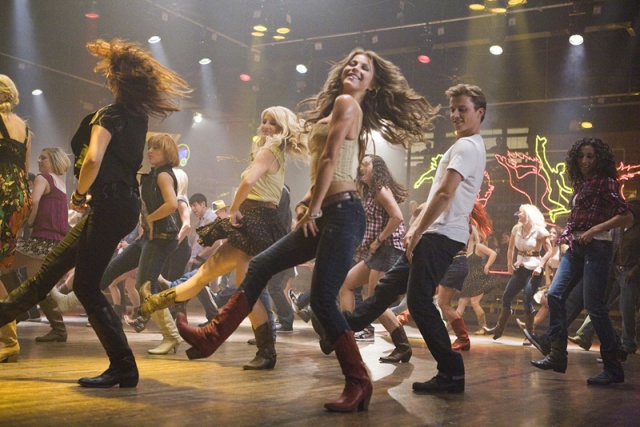
It was a rainy day on Cape Cod today and my daughter and I had planned to see Footloose after I got off work, so we went and got taken away from the rain, and I got taken away from the stress and the fact that I devote hours to planning my classes and I don’t make enough to pay all the bills, by this silly, schmaltzy, fun fantasy world where everyone is so good-looking and can dance so well, and it was worth seeing just for the first part of the “Let’s Here it for the Boy” routine, the cutest moment in any film I’ve seen this year. Man, we loved it! Sometimes, it doesn’t matter what I see. Last Friday, I had wanted to see Take Shelter or The Mill and the Cross, but the arties and the indies don’t get to the Cape until a month or so after their release, if at all, and so I saw The Thing and Real Steel, the latter providing the same sort of silly escapist fantasy as Footloose, and I had a very enjoyable evening.

My favorite movie this year has been The Tree of Life, which I went to see in May on opening weekend in New York City. (It didn’t make the Cape until July.) I’ve been looking forward to seeing Kirsten Dunst in Lars von Trier’s Melancholia, but I knew it might not even make the Cape, and I learned that it was on Comcast, so I decided not to risk missing its theatrical release and watched it three times.


(In way of contrast, I watched von Trier’s Antichrist on Netflix. Interesting connections. Some amazing imagery. Same use of extreme slow motion and some recurrent symbolism: the bridge that’s hard to cross. As for some of the more graphic images, I liked the whetstone bolted to Willem Dafoe’s calf, but his bloody you-know-what was hard to take.)


I love all kinds of movies. I’m an equal opportunity viewer, and I’ll see a movie anywhere, anytime. One of my most memorable viewings of all time was seeing Zulu Dawn with my wife in one of the last, crumbling single-screen cinemas on Market Street in San Francisco where homeless people and pushers and pimps paid the two bucks to get off the streets or hide.